CLAT Exam at a Glance: Everything You Need to Know
The Common Law Admission Test (CLAT) is a crucial milestone for students aspiring to build a career in law. Conducted annually, this national-level entrance exam opens doors to some of the most prestigious law schools in India — including the elite National Law Universities (NLUs). If you're a student in Class 11, 12, or taking a drop year, understanding the CLAT exam structure, syllabus, preparation strategy, and benefits is essential to begin your journey confidently and strategically.
What is CLAT?
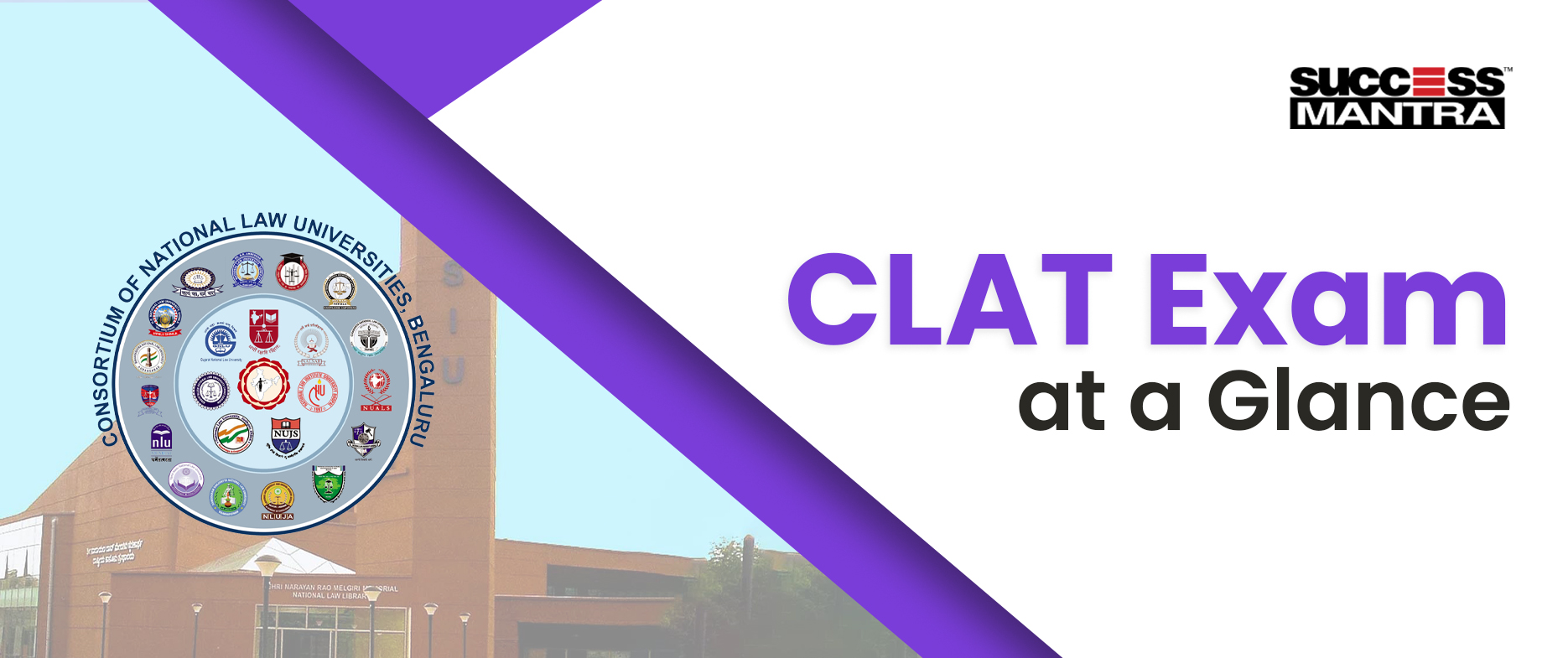
The Common Law Admission Test (CLAT) is an all-India centralized entrance examination conducted for admissions to undergraduate (UG) and postgraduate (PG) law programs offered by 24 National Law Universities (NLUs) across India. It is administered by the Consortium of National Law Universities, which standardizes the pattern and content of the exam each year.
Besides NLUs, several private universities and law schools also accept CLAT scores for admission to their integrated 5-year LLB and LLM programs.
Why is CLAT Important?
CLAT is not just another competitive exam — it's a life-defining opportunity. Here is why:
- Gateway to Top Law Schools: Admission to NLUs such as NLSIU Bangalore, NALSAR Hyderabad, and WBNUJS Kolkata.
- Opportunities Beyond Law: Opens career paths in corporate law, litigation, judiciary, civil services, academia, and public policy.
- Recognized Nationally: Accepted by top private universities and law schools like Jindal Global Law School, NMIMS, and UPES.
- Prestige and Placement: Graduates from top NLUs often secure lucrative job offers, international scholarships, and government positions.
CLAT Exam Highlights
Feature Details
Exam Name Common Law Admission Test (CLAT)
Conducted By Consortium of NLUs
Frequency Once a year (usually in December)
Exam Mode Offline (pen-paper based)
Duration 2 Hours
Type of Questions Objective MCQs
Total Questions 120
Total Marks 120
Marking Scheme +1 for correct answer, -0.25 for incorrect
CLAT UG Exam Pattern
The UG CLAT exam is designed to test your comprehension, critical thinking, logical reasoning, and analytical skills through five major sections:
The UG-CLAT 2025 would focus on evaluating the comprehension and reasoning skills and abilities of candidates. Overall, it is designed to be a test of aptitude and skills that are necessary for a legal education rather than prior knowledge, though prior knowledge occasionally may be useful to respond to questions in the Current Affairs including General Knowledge section.
The UG-CLAT 2025 shall be a 2-hour test, with 120 multiple-choice questions carrying 1 mark each. There shall be negative marking of 0.25 marks for every wrong answer. These questions would be divided across the following 5 subjects:
- English Language
- Current Affairs, including General Knowledge
- Legal Reasoning
- Logical Reasoning
- Quantitative Techniques
English Language
In this section of the UG-CLAT 2025, you will be provided passages of about 450 words each. These passages will be derived from contemporary or historically significant fiction and non-fiction writing, and would be of a standard that a 12th standard student may be able to read in about 5-7 minutes.
Each passage will be followed by a series of questions that will require you to demonstrate your comprehension and language skills, including your abilities to:
- Read and comprehend the main point discussed in the passage, as well as any arguments and viewpoints discussed or set out in the passage;
- Draw inferences and conclusions based on the passage;
- Summarise the passage;
- Compare and contrast the different arguments or viewpoints set out in the passage; and
- Understand the meaning of various words and phrases in the context that they are used in the passage.
Current Affairs Including General Knowledge
In this section, you will be provided passages of up to 450 words each. The passages will be derived from news, journalistic sources and other non-fiction writing. The questions may include an examination of legal information or knowledge discussed in or related to the passage, but would not require any additional knowledge of the law beyond the passage.
Each passage will be followed by a series of questions that will require you to demonstrate your awareness of various aspects of current affairs and general knowledge, including:
- Contemporary events of significance from India and the world;
- Arts and culture;
- International affairs; and
- Historical events of continuing significance.
Legal Reasoning
In this section, you will be expected to read passages of around 450 words each. The passages may relate to fact situations or scenarios involving legal matters, public policy questions or moral philosophical enquiries. You will not require any prior knowledge of law to attempt the questions in this section. You will benefit from a general awareness of contemporary legal and moral issues to better apply general principles or propositions to the given fact scenarios.
Each passage would be followed by a series of questions that will require you to:
- Identify and infer the rules and principles set out in the passage;
- Apply such rules and principles to various fact situations; and
- Understand how changes to the rules or principles may alter their application to various fact situations.
Logical Reasoning
The Logical Reasoning section of the UG-CLAT 2025 will include a series of short passages of about 450 words each. Each passage will be followed by one or more questions that will require you to:
- Recognise an argument, its premises and conclusions;
- Read and identify the arguments set out in the passage;
- Critically analyse patterns of reasoning, and assess how conclusions may depend on particular premises or evidence, and how conclusions may be strengthened or weakened as a consequence of an alteration in premises or supporting facts;
- Infer what follows from the passage and apply these inferences to new situations;
- Draw relationships and analogies, identify contradictions and equivalence, and assess the effectiveness of arguments.
Quantitative Techniques
The Quantitative Techniques section of the UG-CLAT 2025 will include short sets of facts or propositions, or other textual representations of numerical information, followed by a series of questions. You will be required to derive information from the passages or questions, and apply mathematical operations on such information.
The questions will require you to:
- Derive, infer, and manipulate numerical information set out in such passages; and
- Apply various 10th standard mathematical operations on such information, including from areas such as ratios and proportions, basic algebra, mensuration and statistical estimation.
CLAT Eligibility Criteria (UG Program)
Educational Qualification: Candidates must have passed 10+2 or equivalent examination with at least 45% marks (40% for SC/ST).
Age Limit: There is no upper age limit for appearing in CLAT.
CLAT 2026: Important Dates (Tentative)
CLAT 2026 Exam Dates
Look at the table below for the complete schedule of CLAT 2026 exam:
Event | Dates |
CLAT 2026 Notification | May 2025 |
CLAT 2026 application form release date | June 2025 |
Last date to fill CLAT 2026 Application form | October 2025 |
CLAT 2026 Application Correction Window | October 2025 |
CLAT Admit Card | November 2025 |
CLAT 2026 exam day | 06-Dec-2025 (Tentatively) |
CLAT Answer Key | To be announced |
Release of CLAT final answer key 2026 | To be announced |
CLAT results | To be announced |
Top NLUs Participating in CLAT
Some of the most prestigious law colleges that accept CLAT scores include:
- NLSIU Bangalore (Rank #1)
- NALSAR University of Law, Hyderabad
- WBNUJS, Kolkata
- NLU Jodhpur
- GNLU, Gandhinagar
- NLIU, Bhopal
- RMLNLU, Lucknow
- HNLU, Raipur
- NLUO, Odisha
How to Prepare for CLAT
Know the Exam Pattern & Syllabus: Understand the weightage and types of questions asked.
Previous Year Papers: Solve CLAT PYQs to get familiar with difficulty level.
Mock Tests: Practice full-length mock tests weekly to improve time management.
Current Affairs: Read newspapers like The Hindu, Indian Express, and follow monthly GK digests.
Focus on RC & Vocabulary: Daily reading of editorials and opinion columns will boost comprehension and language.
Legal Aptitude: Practice scenario-based legal questions regularly.
Math Practice: Focus on speed and accuracy in basic arithmetic, percentages, and graphs.
Career Opportunities After CLAT
A degree from an NLU is a springboard to multiple high-potential career paths:
Corporate Law: Join top law firms like Shardul Amarchand, Khaitan & Co., or international firms.
Litigation: Practice as an advocate in courts across India.
Judicial Services: Appear for PCS-J or judicial clerkships.
Policy & Research: Work in think tanks, NGOs, and international legal bodies.
Study Abroad: Secure international scholarships for LLM and research.
Academia: Teach law in universities or conduct legal research.
CLAT Coaching & Mentorship
To crack CLAT, aspirants often benefit from:
- Structured coaching programs
- Personalized mentorship
- Guided test series and feedback
- Access to curated study material
Platforms like Success Mantra Smart Coaching provide scholarship tests, mock exams, and demo classes that simulate real-exam conditions and help you assess your readiness from Day 1.
The CLAT exam is more than just an entrance test — it's your gateway to the world of law, justice, governance, and impact. With thousands of aspirants and limited seats in NLUs, early preparation, strategic planning, and consistent effort are crucial.
Whether you choose to study through self-paced learning or professional coaching, the keys to success are:
- Clarity of concept
- Consistency in practice
- Confidence in approach
Ready to Begin Your Journey?
Join our Scholarship Test, attend free demo classes, and take the first smart step towards cracking CLAT 2026. Your dream law school is just one decision away!